

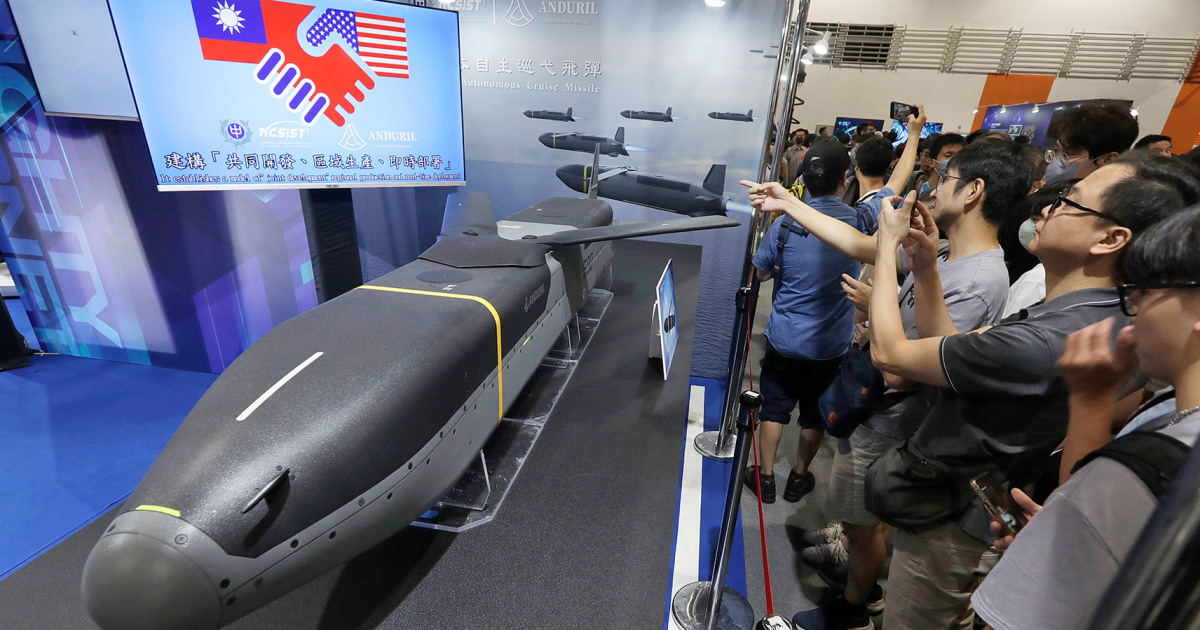
The move followed the announcement of a U.S. arms-sale package valued at more than $10 billion that drew an angry response from China, which claims Taiwan as its own.
Beijing imposed sanctions on Friday against 20 U.S. defense-related companies and 10 executives, a week after Washington announced large-scale arms sales to Taiwan.
The sanctions entail freezing the companies’ assets in China and banning individuals and organizations from dealing with them, according to the Chinese foreign ministry.
The companies include Northrop Grumman Systems Corporation, L3Harris Maritime Services and Boeing in St. Louis, while defense firm Anduril Industries founder Palmer Luckey is one of the executives sanctioned, who can no longer do business in China and are barred from entering the country. Their assets in the East Asian country have also been frozen.
The announcement of the U.S. arms-sale package, valued at more than $10 billion, has drawn an angry response from China, which claims Taiwan as its own and says it must come under its control.
My sympathies are absolutely with Taiwan in this.
I hope when Xi is out that maybe China will finally recognize Taiwan as an independent country.
Regarding China sanctioning American companies over this, they are just using the American rule book, that USA has so often used against China. So there is no reasonable way we can call foul over that.
Considering they are weapons manufacturers, were they likely to be selling anything to China? I know we spread the weapons around, but I thought we specifically don’t sell to China, Russia, Iran, and some others.
Who you mean by “they” is a bit unclear to me, but I bet neither USA or Taiwan are selling weapons to China.
I am also sure that part of the increased tension is because USA has sanctioned TSMC from selling high grade chips to for instance Huawei.
China has had good reason to be pissed at the “west” for a long time, unfortunately they now behave just as bad.
But as I see it, USA absolutely started this shitshow.
PS: Recently there were talks that even Turkey who is a NATO member couldn’t be allowed to receive high tech NATO weapons. Because they made an agreement buying Russian equipment that required Russian technicians to teach their use.
This was considered a security risk, as it might give Russians access to sites that had NATO equipment.
So most definitely no NATO country is selling weapons to China, Russia, North Korea or Iran. I think Taiwan has a defense agreement with USA, that would prevent them too even if they wanted to. But I doubt they want to give weapons to their biggest security threat.
The they I was referring to are the defence manufacturers that China just slapped with tariffs. Seems to be performative.
Whether they deliver to China is completely irrelevant in that respect.
It’s what they buy from China that is important. And it’s also what their suppliers buy and sell to China.
China has monopolies on rare earth elements that may be very tough for some of these companies to lose access to.
Don’t for a second think that USA has the upper hand in this situation, because that time has passed, on international trade China is now their equal, and on rare earth resources China has a very decisive upper hand.
For instance the very powerful magnets needed for much high tech equipment, is near impossible to make in quantity without access to rare earth minerals that China control.
Looks like some “independent” corporations will need to make some rare earth pizza ovens then, since they applied them to corporations, and not the US as a whole. As I said, performative. Looks like China is trying to get trump to apply a ton of tarrifs, so that they have cassus belli, or reasons to continue the trade war.
Hold on… You’re still expecting reasonability?
China was progressing before Xi, before Xi relations between Taiwan and China were a lot better than they are now.
I hope they can be better again after Xi.
You think the issue is Xi? From 1950 to 1992 the KMT was a fascist government on Taiwan killing political dissidents under martial law. The only reason that it wasn’t stopped is because the UK and US protected the KMT from the minute they lost the civil war.
The reason there is greater tension with Taiwan under Xi is because the US has ramped up its rhetoric, its military collaboration, and its diplomacy with Taiwan while Xi is in office. The CPC has always considered Taiwan part of China, and the KMT have always considered Taiwan part of China. The problem has always been the West intervening to create conflict and protect fascists.
Both sides were way worse in the past, but no it is not the west or USA that has been feeding this dispute.
Both sides need to recognize the current situation of China and Taiwan being autonomous states as the status quo. And that from a humanitarian perspective both sides are best served by staying separate.
But today Taiwan is a democracy AFAIK, with elections every 4 years. While China remains totalitarian. So the fascism in the form of totalitarianism is clearly on the Chinese side now, even though they call it Communism, it’s actually closer to Fascist Germany during WW2, than it is to anything normal people would call socialism.
Taiwan is a Western-style parliamentary democracy. This is not the only way to run a democracy. China is a Communist democracy, with elections being only one of the ways that people can have influence over there governance. There’s a reason why 95% of Chinese citizens are happy with their government (these numbers come from a study Harvard conducted over 15 years and do not reflect Chinese government reports).
The idea that China is fascist is laughable.
If that’s what you believe, then it’s no wonder you think Taiwan should be independent. It’s not true, but it’s understandable.
In theory you could have democracy with only one party, but AFAIK that’s not really how it works in China.
Who people can vote for is decided by the party, and AFAIK not everybody can become a member of the party, and participate in that decision.
Also only one party means only one party program, and that can never be democracy, as when people vote, there is only one party program to vote for.
It’s also not a democracy if certain viewpoints are oppressed, which is very much the case in China, and which we have seen very clearly in Hong Kong.
But yes China has some level of a very very flawed democracy, and there is a visible path for improvement within the system, when the political landscape allows for it.
But as we have seen with the American flawed democracy, the powers that be may be very hesitant to yield power to a more democratic structure. In that way USA has failed for about 200 years. Hopefully the Chinese model allows for a bit more progress than we’ve seen in USA.
Regarding the 95%, that is very high, but I have no doubt that the government/CCP is very popular, after half a century of strong economic progress, with actual progress to the population too, I’ll even go so far as to say it’s well deserved.
But on the humanitarian side, and respect for minorities, China is still way behind. It is also a country with death penalty, which is clearly contrary to democratic values.
The most visible signs are oppression of opposition, which is 100% undeniable. And also oppression of the truth through censorship, the 1989 Tiananmen Square protests and massacre is still illegal to even talk about. So no processing of the mistakes, and no learning from them. These are the 2 clearest markers of a totalitarian system.
As I wrote, fascist as in authoritarian, and it is a fact, IDK why you consider facts laughable?
Who people can vote for is decided by the party, but that decision making process involved elections within the party. You are correct that there is not universal participation in the party in China due to the requirements of becoming a party member. There are 100M citizens in the party, which is a small percentage of the population.
This is where words matter. The system is, in fact, democratic, but governing power is not universal. This is true of all democracies all over the world, including Western ones. The question becomes one of the size and influence of the franchise, not a question of whether its democratic. The size of the party in China is small, and there are efforts underway to increase it They added 1M members to the party in 2024. That’s too little, but it is openly discussed and the party is clear that both they need to expand the party and they have to prevent disruption of the revolutionary government by outside forces. It is a delicate balance when only 70 years ago they were a peasant society undergoing a civil war in which the Western imperialists were invested. It’s made much more difficult by the subsequent years in which the US destroyed Korea, Vietnam, Cambodia, and Laos, trained and airlifted terrorists into Tibet, built a massive drug running operation through Thailand, etc.
However, the other question about democracy is whether the demos, the people, actually can change the policies of the state, the kratos. And as it turns out, the party is incredibly responsive to the people. That’s why the people approve of the work the party is doing - because the party listens to the people. As you say:
This isn’t really true in one-party systems. One-party systems have factions and the factions all fight for their program within the party. It’s a governed form of conflict, and it works because it doesn’t really afford for the sorts of manipulation that we see in the West. Factions have to fight for their platform according to rules of engagement, and the platforms that rise to the top are the ones that run the party. There is accountability at the platform level in these systems. Again, unlike in the West where it is very well understood that people will campaign on a platform and then not implement any of it and there’s nothing anyone can do about it.
The joke is that in the US, you can change the party but cannot change the policies, while in China you can change the policies but cannot change the party. And the question is - which one is more democratic? Is it the country where the popular will of the people is what drives the policies or is it the country where the popular will of the people only drives which people inhabit offices but where the majority of people actually oppose the policies?
That’s not a theoretical question either. Research from Princeton shows that popular opinion does not matter at all in the US. Laws pass at the same rate whether they are popular or unpopular. They also shows that the primary determinant of a law passing is whether the top 1% of wealth holders approve of it. This is not true in China. The Harvard study that showed that 95% of Chinese citizens approve of their government is because it is responsive to their needs, which means they voice their opinion and their opinion is incorporated into policies.
The US outlawed the communist party, blacklisted every communist sympathizer they could find, killed black organizers, and has been oppressing viewpoints for a century, but because you can elect different parties, people think its a democracy.
As for Hong Kong, we can learn a lot about Chinese politics by examining it. The Hong Kong protests raged for weeks with protestors throwing fire bombs at police. That would never happen in the US because the US would brutally put such protests down very quickly. Chinese police, however, we given orders to disengage when things got too violent. Their role in Hong Kong was to prevent the protests from getting totally out of control, essentially to let the protestors express their anger for as long as they needed for it calm down and become more civil.
We can also learn a lot about it from the commentary of the citizens there. The people of Hong Kong that were protesting were a small minority and mostly in a specific age range between late teens and mid 30s. The elders were not protesting and in fact shunned many of their own young family members who protested. And the reason is because of the way Hong Kong “democracy” came about. Hong Kong was ripped away from China by the British as part of the British’s spoils from the Opium Wars. Brits in Hong Kong were immune to the law. They would abuse the residents without consequence, and the Chinese living there were living mean lives.
That changed when the Brits realized they would not be able to keep Hong Kong. As soon as they realized China was on the rise and intended to not renew their lease of the island, the first thing the Brits did was consider if they could force China to renew the lease by force, but the analysis was that this would be a bad idea. So instead, the Brits completely reformed Hong Kong and created a middle class, and elevated the most loyal servants of the Brits into bankers to give them huge salaries and bonuses, and they created a parliamentary democracy that they controlled and propagandized everyone through their control of the schools. And they did this specifically to make reintegration with China as hard as humanly possible.
And China knew this. And they knew they had to balance national security and the self-determination of the people of Hong Kong. They knew eventually they would come around to Chinese governance, but that they couldn’t force it. But they also knew that if they let Hong Kong be totally free it would be used as a launching point for Western terrorism and separatism, just like the Brits and Americans always do. So when China passed a law cementing the national security rules they felt were necessary, it sparked a protest, and it was couched in the language of “pro democracy” even though the Hong Kong governance structure was being left in place.
To me, that’s not totalitarianism. To me, that’s measured governance.
But these are two very different experiences. China is under siege, being surrounded by nuclear military bases. The US has no such threat. Similarly, the powers that be in the US do not listen to the people at all, and consistently have terrible approval ratings, whereas the Chinese government is constantly working on their process of listening to and addressing the needs of the people. The flaws are in no way equivalent.
We can have this discussion, but it’s very fraught. The reality is that Tibetans have their own autonomous state within China, they educate their children with the Tibetan language and their culture thrives, whereas in the US Indian reservations are horrible places where traditional religions are barely hobbling along and languages are dying because of the repression. Structurally, China is far better for multiculturalism than the US is. As for the death penalty, I disagree it’s contrary to democratic values. Democracies around the world and throughout history have had the death penalty and it didn’t make them undemocratic. China’s use of the death penalty to protect the public good from people who betray the public trust is sort of wonderful compared to the fact that we fine businessmen a few million when they kill a thousand people through deliberate negligence just to make some money.
At this point, you’re just smearing your words together. It sounds like you’re saying Totalitarian == Fascism == Authoritarian
That’s just not how I’ve seen these words get developed. Authoritarian is the systemic use of authority to achieve goals. America is more authoritarian than China - it imprisons more of its people, it uses violence against the entire world, and it even has official decrees from the president called executive orders. China, on the other hand, does not allow the president to issue unilateral executive orders, but instead requires all such decrees to go through the structures and processes of the party. It has fewer of its people in prison, and its prisons are focused on rehabilitation instead of authoritative retribution, as evidence by its very low recidivism rates. It also hasn’t dropped a bomb since 1989.
I’m out of space. But suffice to say these words aren’t equivalent, and nearly everything you can point to about China can be applied to the US, to the UK, etc, and often in worse ways. The systems are different, they have different shapes and manifestations, but China is not somehow obviously evil compared to the West.
That’s less than 10% of the population, and still everybody can only join under one party program. That’s not democracy.
No it isn’t, you claiming that only shows you don’t understand what democracy is.
That is mostly irrelevant, it’s the lack of political freedom that matters. Here we have 12 parties in parliament, no less than 2 of them are new parties, that sprung from older parties because they wanted to change the political agenda. Such an option does not in any way exist in China.
No they don’t, and they already don’t allow anyone to express such opinions anywhere else, it’s even easier to prevent it within the party. That point is pure bullshit. It’s the authoritarian paranoia that fears change, even if a majority of people want it. But here the CCP fear even the MENTION of change!! The only thing worse is autocracy, where a single individual holds all power.
But still people are not allowed to ask for democracy.
The same is true when you have 12 parties, the difference is that in CCP you have to stay within what is allowed under one party program. In a democracy you can do the same but within many different party programs that span a wider spectrum, where in an authoritarian country many of them would be illegal.
I already mentioned that USA is a deeply flawed democracy, that has failed to improve their democracy. In Scandinavian countries the Communist party is absolutely 100% allowed and legal. But In Denmark when the Soviet Union collapsed, the Danish Communist Party went bankrupt because support from the Soviet Union dried up. And there was so little interest that the communist party doesn’t exist here anymore. We do however have a number of left wing parties that are based on social democracy. Denmark has one of the highest democracy ratings in the world, so when arguing on how democracy works, you should use a functioning democracy as example and not the very flawed democracy of USA.
In a democracy demonstrators don’t generally throw bombs at police, because the demonstrations are allowed, and their political viewpoints are allowed, and police does not try to arrest peaceful protestors.
Nice to hear there is some humanism, it didn’t go so well at Tiananmen Square square in 1989.
But yes I’ve been aware for years that the Chinese “thought police” is not as ruthless as it once was. For instance an Internet blogger criticizing the system is not even necessarily imprisoned, but instead the blog can be taken over by authorities, and the content switched to state propaganda. A way more humane approach that is still efficient.
Progress has been made, but silencing opposition is not democracy.
Everything you write about Hong Kong sounds like propaganda. But the part about Western Terrorism is weird. There is no reason to believe terrorism would somehow be carried over from the west to China. If a person from Hong Kong perform a terrorist act in China, that is 100% a case of Chinese terrorism.
Nukes can be intercontinental, so geography is not so relevant. And China is surrounded by Russia, Kazakhstan, India and a bunch of smaller countries, none of those countries would ever stand a chance against China in a war. India and Russia have nukes, but why would China be afraid of being attacked by them?
The idea that China is under siege is exactly what a totalitarian regime would claim before invading another country, just like Putin did before invading Ukraine.
Are you saying China is planning an invasion?
As I’ve mentioned already, USA is a very flawed democracy, and some of the dissatisfaction is due to this, they have options, but no good options.
In China however, the people don’t have an alternative political party with an alternative offer to compare the Chinese government to. And considering the development has been generally good for quality of life in China, it is understandable that the majority of Chinese population is pretty happy with how things are going.
I recently watched a Norwegian youtuber called Bjørn Nyland who test drives electric cars, and who went to China, to try some of the new Chinese electric cars. And he filmed freely in China (Shenzhen), something that would not have been possible just a few years ago. But it’s also amazing to see how modern Shenzhen is, and the number of cool eating places is insane. Very clearly the places he visited people had very high living standard. Probably a good bit above average for China, but goddam it looked nice.
I can understand why people in China think things are generally good, and are happy with their government, in some ways they have done an extremely good job.
It’s funny how you continue to use USA as an example, you should be aware that USA is not respected in this regard in Europe. USA is in many ways worse than China.
As a democracy they are a joke that we call only one party better than China. They have a horrible history of slavery, and the racism continue to be high despite being a multicultural society for 2 centuries! They don’t have healthcare for all, like every other democracy, and they don’t have paid education.
You are not really making much of a point by pointing out that USA sucks too.
BUT!! Think about this, among one party countries, China stands as a shiny beacon above the rest. Whereas USA as a democracy is rock bottom in almost every aspect, except they have a huge economy.
USA is about to fall into one party authoritarianism, What do you think the chances are? Will the people be better off with just one party?
They have traits in common, Totalitarian is dictatorship by one ruler, Authoritarian is centralized rule that does not allow political opposition much like China.
One of the main aspects of fascism is that it is always authoritarian or totalitarian. So being authoritarian means being similar to fascism in some of their main aspects.
But == usually means identical, and I never claimed that. Just that China being having an authoritarian government, means it shares significant similarities with fascism.
By definition democracy is supposed to be the opposite of authoritarian, but most definitely USA is the most authoritarian and also most flawed democracy that exist.
USA is the most unjust democracy in the world,
Yes even Americans are beginning to realize that. Unfortunately China is beginning to behave a lot like USA, which I don’t really blame them for, especially the 2nd term of Trump has been awful for relations between China and USA, but I’m afraid it has also put a strain on relations between China and EU. I find the Nexperia debacle particularly embarrassing for EU. Had it been bought by a company from any other country, there wouldn’t have been a problem. But because it was China, and Trump somehow thinks it his job to make as much pain as possible for China, USA pressured EU and Netherlands to prevent China access to a company they bought fair and square under EU regulation!? Apparently the situation is being resolved, but here should never have been a “situation”.
Good. 👍 That may explain why China seems to generally behave more balanced and intelligently than USA.
I never claimed that, I have great respect for what China has achieved in many ways, China seems to respect the sovereignty of other countries, but for some reason Xi is hellbent that Taiwan must be reunited with mainland China. Why not accept that Taiwan is now a different country from China? And try to work together, China is the most obvious major economic partner for Taiwan anyway.look at Russia trying to “reunite” Ukraine, it has made life hell for millions of people. With no benefits for either side. The soviet union was legally dissolved in 1991, why not accept that? And in the same way, why can’t China accept that for all practical purposes Taiwan is an independent country now?
Interesting debate, although I disagree at times, you put forward a reasonably balanced argument IMO.
Now I’m out of space too. 😋
And it’s 02:30 here now, so I say goodnight. 🥱 💤